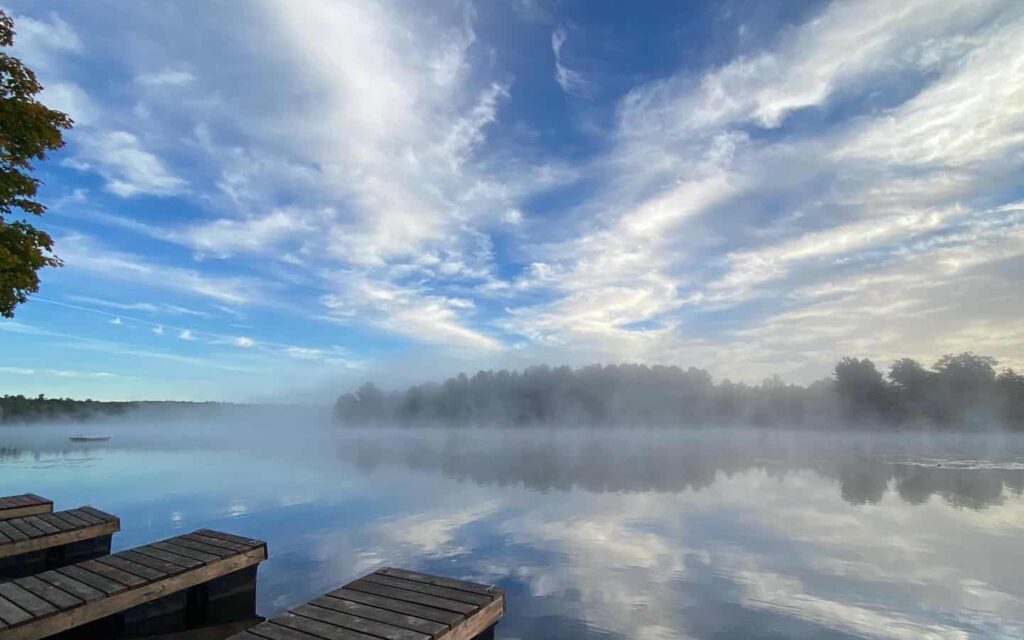
As a satellite facility of the Queen’s University Biological Station, the Elbow Lake Environmental Education Centre offers curriculum-based programs year round that encourage students to explore and measure local biodiversity through field-based scientific investigation.
Our Programs
Our curriculum-based programs complement in-class lessons, teaching ecological principles and offering more in-depth study and hands-on experience in a variety of areas. These programs are a great fit for private schools, ESL classes, Eco-Teams, and home-schooled students!Our school programs are aligned to meet the needs of science, geography and environmental science courses, and for students from kindergarten to college.
In Person Programs Click Here for more information and how to book.
Fisheries & Aquatic Ecosystems
Studying the diversity of fish species can help scientists assess the health of an aquatic ecosystem. In this workshop, students will have the opportunity to catch fish using seine nets and learn about common fish species in Elbow Lake. We will discuss how humans may impact fish populations, with things such as climate change and overfishing.
*This program is season specific and can only be done when the lake water is warm (May – September).
Diversity & Adaptations of Birds *Updated Program*
The wide diversity of bird species in Ontario provides an excellent way to observe physical adaptations. Through hands-on activities, students will learn about how the different structures of a bird (feet, wings, beak, etc.) are adapted to help them survive. We will also discuss common birds seen in the Kingston area and how to identify them. The species that are focused on will differ depending on the season and what species are currently present at Elbow Lake.
Field games involving migration and the use of our binoculars will also be included.
*For younger grades, after students learn the features of a bird, they will work in groups to apply their knowledge and create a bird of their own, developing a life history profile and presenting it to the class.
*For older grades, there is an optional program that includes Classification and Dichotomous Keys. Identification and differentiation of species is an integral part of the study of life. Students will learn how dichotomous keys are formed, based on morphological differences and similarities between species. This workshop can be tailored so that students design their own dichotomous keys, and/or get experience using an existing key for birds. A selection of bird specimens will be available for students to handle, providing a close-up view of these amazing adaptations!
Winter Ecology Program
Discover what is living under the snow and ice. Learn about a season that many know little about! We have so many activities to partake in during these winter months!
Put on a pair of our snowshoes to navigate over the deep snow,
use our ice fishing rods to see what fish are lurking below the ice,
send an underwater dredge to investigate what invertebrates are living on the bottom of the lake,
sample lake chemistry,
search for animal tracks in the snow to learn what animals are still moving about,
discover the different strategies that local wildlife use to survive the winter,
and much more!
Tree Identification & Forest Assessment
Biologists, geographers, foresters, ecologists, and historians can all use the study of trees to learn about the local ecosystem. Groups will have the opportunity to learn about and use field techniques (such as transects, calculating tree size, and tree cores) to study biodiversity of forest ecosystems. Students will also learn how to identify common tree species in Ontario using dichotomous keys. We will discuss sustainabile forestry practicies and how to be a concious consumer.
Limnology & Ecosystem Health
A part of limnology is the study of the extremely small, free-floating organisms called plankton. Students will learn about the importance of plankton in the aquatic food web and how these organisms can indicate the health of the ecosystem. Furthermore, we will discuss how humans affect plankton populations and the overall health of the aquatic ecosystem. We will discuss the human impacts on an equatic ecosystems, including the introduction of invasive species. Each group will collect their own sample from Elbow Lake and observe what they cantch under the microscope.
Terrestrial Insects
Macro-invertebrates are organisms without backbones and can be seen with the naked eye, including flatworms, crayfish, snails, and many insects. Students will have an opportunity to catch terrestrial and aquatic macroinvertebrates, identify them, and learn about the importance of these organisms in a healthy ecosystem.
Invasive Species
An invasive species is a group of organisms which are introduced to an area and have no natural predators, often resulting in uncontrollable numbers. Students will learn about some well-known invasive species in Ontario, how organizations try to control them, and what we can do to prevent them in the future. Students will also experience controlling an invasive species at Elbow Lake!
GPS Scavenger Hunt
Elbow Lake’s property contains a variety of habitats and species that are ideal for data collection. Groups will learn how to use a GPS and map to navigate to stations on the Elbow Lake property. At each station, students will complete tasks to learn about wildlife and ecology that relate to the current season. Spring, Summer, Fall, and Winter programs available.
Cartography: Mapping your environment
Though digital maps are everywhere, the ability to read and create a paper map is still important and provides fundimental skills. This workshop teaches students the characteristics of a map, how to calculate scale, and the different types of maps. Students will choose features on the Elbow Lake property that are relevant to their map’s theme and translate it to a flat medium.
Water Chemistry
Take water samples and analyze the chemical makeup of the lake and wetlands near ELEEC. Complete the chemical equations for each of the steps of our analysis. Use this data to make inferences of ecosystem productivity and the types of wildlife that lives within.
Orienteering & Geocaching
Learn how to use a map, compass, and GPS. Then use these skills to find Geocaches hidden on our site and learn about ways that they can be a good steward of the land.